How to Split Players Into Fair Teams (Without Arguments)
Learn how to divide players into balanced, fair teams without conflict. Master techniques for splitting players equally and creating competitive matches.
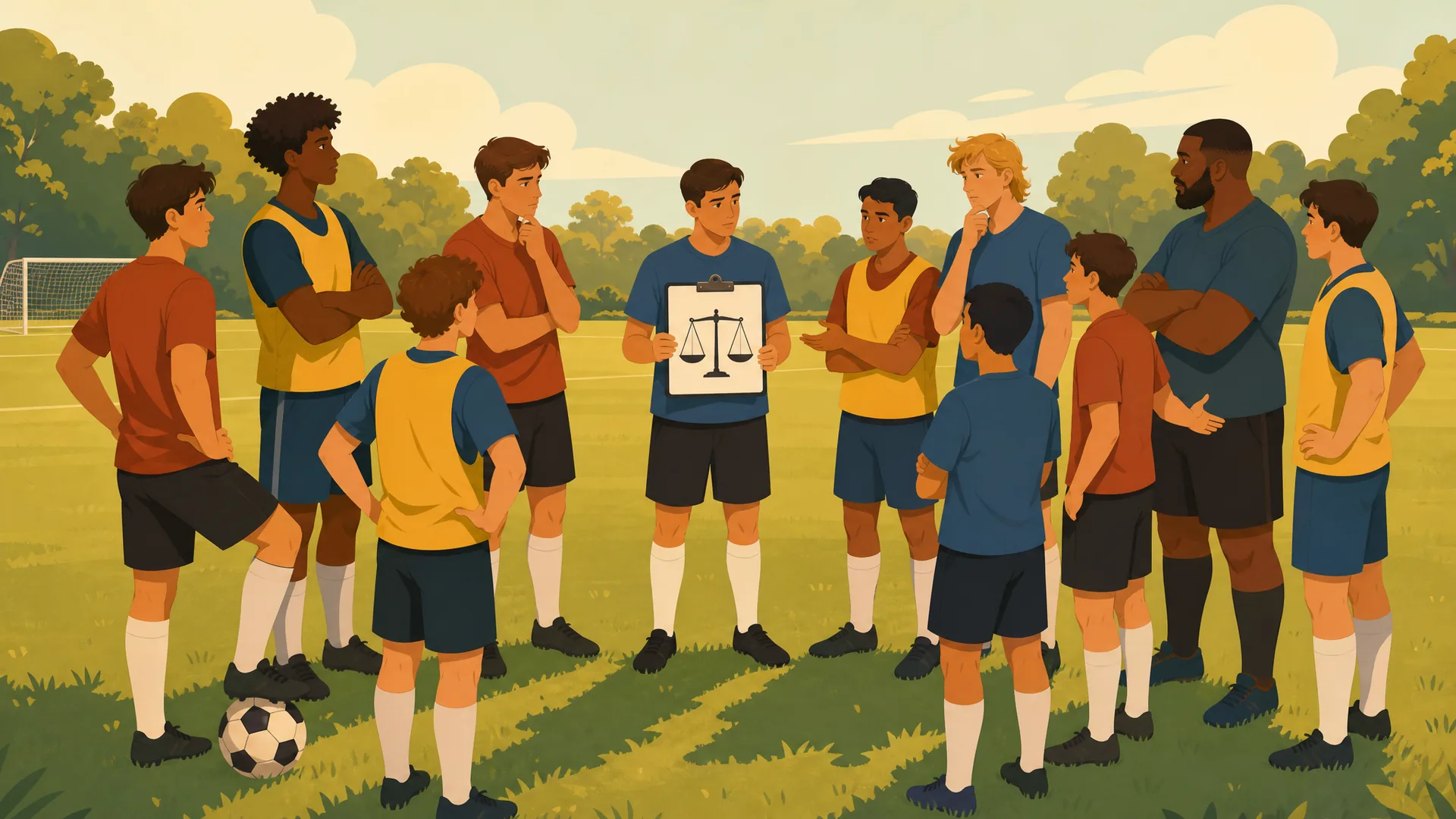
Every pickup football organiser has lived this scene. The group turns up, someone shouts "let's split the teams", and within seconds the argument starts. Uneven teams are not just a cosmetic detail. They decide whether the match is fun or frustrating. And the person carrying that weight is always the same one: the organiser.
Try the automatic team balancer
This guide shows how to split players into fair teams without relying only on the organiser's gut feeling. It also compares the most common manual methods with a faster route: an algorithm that builds the line-ups for you.
Why splitting players into fair teams is so hard
Building balanced teams sounds simple until you try to do it for real. Every player has a different skill level, a preferred position and a form curve. Weighing all of that up on the spot, without data, is close to impossible.
The problem with the organiser's gut feeling
Most people trust their memory when separating players. The problem is that memory fails and it is selective. Organisers remember close friends and recent players better. That skews the assessment, even with the best intentions.
Take a weekly kickabout with 14 players of very different levels. In that classic scenario, picking "by eye" always produces the same two or three strong sides. The result is predictable: the same group wins almost every week.
How arguments about uneven teams ruin the mood
When one team wins by a landslide every week, the game loses its appeal. Players start complaining before kick-off. Some simply stop showing up.
That erosion lands on the organiser. They end up firefighting instead of playing. Solving this in a structured way is the first step to keeping the group active.
The most common manual methods for balanced teams
Before talking about automation, it is worth understanding the traditional methods. They show up in nearly every guide on building amateur football teams. Each has merits, but also clear limits.
Draft or captains picking
The draft is the best known method: two captains pick players, one at a time, until the teams are formed. It is quick to explain, but expensive in another sense.
Captains picking one by one is embarrassing for whoever gets chosen last. It also rewards friendships over ability. In practice a captain draft is not a neutral method. It reflects the personal perception of whoever is picking, not an objective read of the group.
Ranking or skill-list split
Another approach is to write a list with each player's level and alternate the names between teams. It works better than a draft at avoiding awkwardness.
But that list is usually subjective, based on the organiser's memory and opinion. Without clear criteria it reproduces the same biases as the draft, only more quietly.
Random draw
A random draw solves awkwardness and subjectivity in one second. Everybody is drawn, with no favouritism.
The cost is balance. A pure random draw can stack the best players on the same side by sheer luck. It works as an emergency method, not as a recurring solution.
What makes a team-splitting method genuinely fair
A fair split goes beyond asking "who plays best". Balanced teams depend on several variables that interact during the match.
Criteria beyond skill: position, fitness and history
Technical ability is only part of the equation. It is worth weighing position, physical condition and recent performance before forming the teams.
A side full of forwards with no defender suffers, even when the individual players are good. A player who has had three poor games counts differently from someone in form. Ignoring those factors is one reason teams that look "balanced on paper" end up lopsided on the pitch.
Why human decisions carry unconscious bias
Even well-intentioned organisers carry bias. It is natural to trust the people you know well and underrate those who play less often.
That bias is not carelessness. It is a natural limit of any manual assessment made from memory, under time pressure, minutes before kick-off.
How to split players into fair teams step by step
There is a repeatable process for balancing teams, whether you do it by hand or with a tool. Here is how to apply it in practice.
Step 1: collect consistent player data
Before splitting anything you need reliable information. Skill level, main position, fitness and recent attendance are the minimum data set.
Without those recorded somewhere, every match day becomes a memory exercise. And memory, as we have seen, fails.
Step 2: define your balancing criteria
Decide what matters most in your group. More competitive groups may prioritise skill and position. Casual groups may only care about spreading the strong players evenly.
What matters is having fixed criteria, applied the same way every time. That stops the split from changing with the mood of the day.
Step 3: generate and adjust the teams before kick-off
With data and criteria in place, build the teams before everyone arrives at the pitch. That avoids rushed decisions at the last minute.
Once the teams are generated it is always worth a review. Small last-minute tweaks, such as an unexpected absence, still belong to this step.
Manual method vs algorithm: comparing the two routes
Everything above can be done by hand. The question is whether it is worth the time and effort, week after week.
Time spent: minutes vs seconds
Building teams manually, even following the steps above, takes time. You have to check your notes, test combinations and start over when something does not add up.
An algorithm does that calculation in seconds. It cross-references player data and returns balanced teams almost instantly, without testing combinations one by one.
Consistency: variation between match days
A tired organiser in a hurry tends to simplify the criteria and make mistakes. The outcome varies from week to week, even with practically the same group.
An algorithm applies the same criteria every time, without fatigue and without rushing. That reduces the variation between one match and the next.
Scalability: small vs large groups
Splitting 10 players by hand is tedious but workable. Splitting 30 or 40 players across a recreational league, with multiple teams and rotation, is another story.
Amateur teams that swap the whiteboard and the WhatsApp group for a management app report a big drop in the time spent organising each match day. The bigger the group, the bigger the advantage of automating the calculation.
How FootDraw calculates balanced teams automatically
FootDraw was built to remove exactly this bottleneck. Instead of relying on the organiser's memory, the automatic team generator does the heavy lifting for you.
Automatic generator based on player stats
The algorithm uses the performance and position data of every registered player. With that it builds balanced line-ups in seconds, before the group even arrives.
It is the same logic as the manual step-by-step, applied automatically and without bias. More than 1,000 amateur teams worldwide use FootDraw to build line-ups and organise their matches.
If you want to see how it works in more detail, take a look at a team balancer app for football and how it applies to your group.
Quick manual adjustments when you need them
The algorithm does not take control away from the organiser. Once the teams are generated you can review and adjust before confirming the line-up.
That matters when a player drops out at the last minute, or when you want to try a different combination. Manual adjustment stays available, but as the exception rather than the rule.
Splitting fair teams across different formats
The format changes what counts as a "fair team". A 5-a-side kickabout has a different dynamic from a recreational league with dozens of players.
5-a-side and 7-a-side
In smaller formats every player weighs heavily on the result. A single player out of form can unbalance the whole team.
Here, criteria such as position and fitness matter as much as skill. Small groups feel any imbalance from the first passage of play.
Recreational leagues with player rotation
In bigger leagues with rotation between rounds, keeping teams balanced week after week is even harder by hand. The organiser has to remember who played with whom, and which teams have won too much.
A structured process, with saved data for each player, solves that without demanding perfect recall every match day.
Common mistakes when balancing teams (and how to avoid them)
Even well-meaning organisers fall into the same traps. Knowing them helps you avoid them next time.
Ignoring player positions
It is common to build teams looking only at overall skill, without considering position. The result is a side full of forwards with nobody defending.
Balancing by position as well as ability avoids that structural imbalance, which otherwise only shows up once the game has started.
Trusting memory instead of data
The most frequent mistake is simply trusting your recollection of who played well or badly. Memory is selective and favours whoever plays most often or is closest to the organiser.
Recording basic data for each player, even in a simple form, already cuts that bias significantly. That record is what makes automating the process possible later.
If you have read this far, you have probably recognised some of these mistakes in your own group. The most direct way out is to stop relying on memory and let the algorithm do the calculation. Sign up to FootDraw for free and start creating balanced line-ups for every match, without an argument before kick-off.
¿Listo para organizar tu equipo de fútbol?
Crea equipos equilibrados, organiza partidos y sigue las estadísticas — todo en un solo lugar.
Crear equipo