
How to Balance Teams for Pickup Soccer Every Time
Learn how to balance teams for pickup soccer every time. Use automated tools to ensure fair matchups and skip pre-game arguments in 2026.
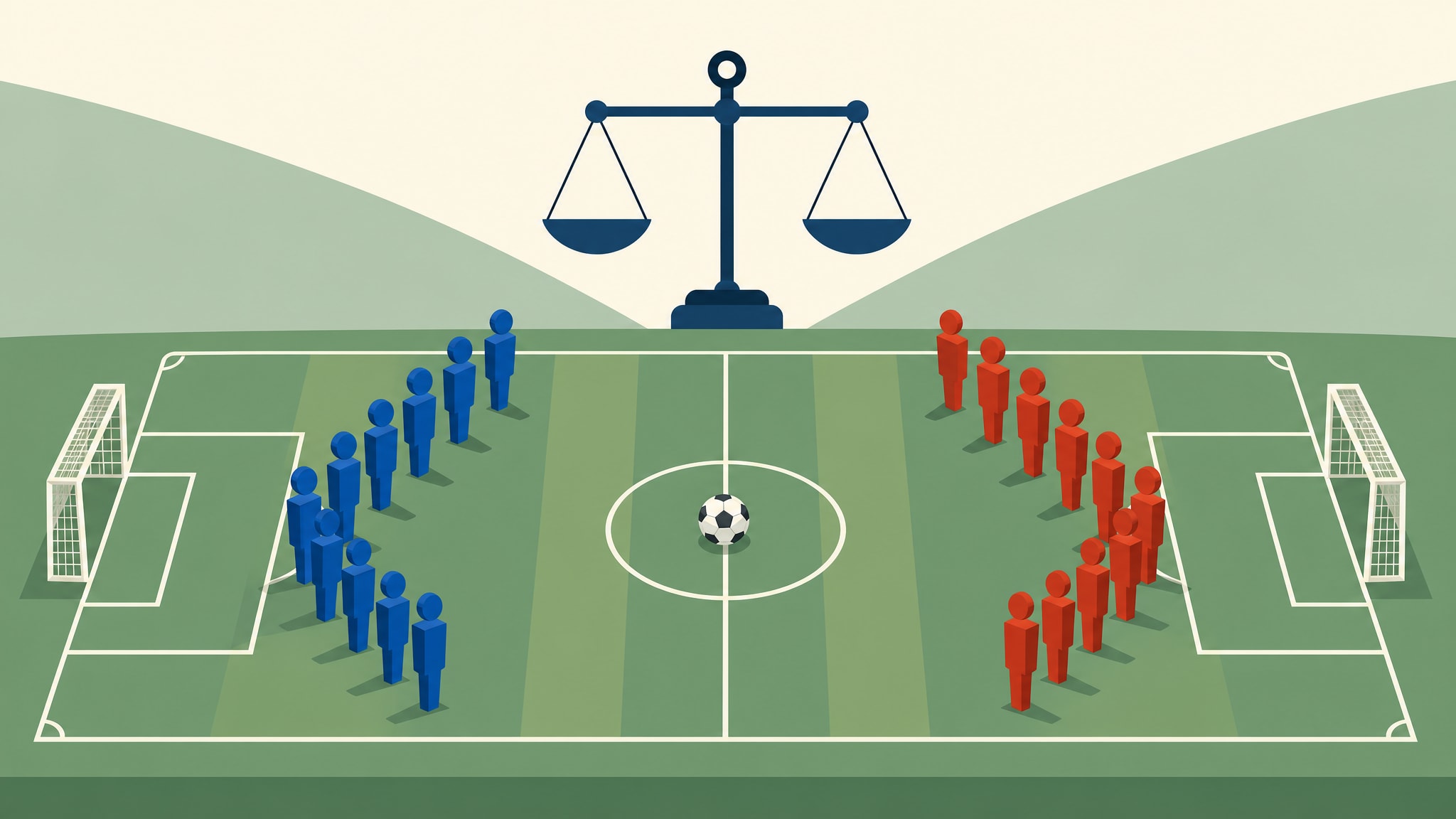
You know the feeling. Twenty minutes arguing over teams before a single ball gets kicked, then one side dominates for an hour while the other checks out mentally. Learning how to balance teams for pickup soccer isn't about perfect mathematics. It's about removing the friction that kills recreational games before they start. Manual methods rely on memory and bias. Automated tools now handle this instantly so you can play instead of administrate.
Why Manual Team Balancing Fails Pickup Games
Relying on your own judgment or group consensus to sort players introduces errors that no amount of good intention fixes. You might think you know everyone's ability level, but cognitive shortcuts skew the matchups against the fairness you're trying to achieve.
The Bias Problem in Eyeball Assessments
Human brains weight recent events over long-term performance when judging athletic ability. A player who scored a hat trick last week gets rated higher than the consistent midfielder who quietly controls every game but rarely finishes chances. This recency bias creates uneven teams, because memory favors highlights over reliability, and the result is lopsided scores that frustrate everyone involved.
Social dynamics distort manual assessments further when friends advocate for each other or avoid appearing too competitive. Loud voices in the group chat push their preferred teammates onto stronger squads, while quieter players accept weaker positions without complaint. These invisible social pressures mean even well-intentioned organizers produce unfair results, since subjective evaluation can't separate friendship from skill.
Time Lost to Pre-Game Negotiations
Every minute spent debating team compositions is a minute stolen from actual play and warm-up. Players arrive expecting to compete, not to stand in circles while captains haggle over who deserves which teammate based on outdated perceptions. This administrative drag cuts field time and lowers the energy before kickoff even happens.
Disputes over perceived imbalances create resentment that carries into future sessions. When players believe the sorting was rigged or careless, they disengage from the match regardless of the scoreline. Manual balancing often results in one dominant team winning repeatedly, and that causes drop-offs in participation as frustrated players stop showing up.
Core Principles of Fair Pickup Soccer Teams
True fairness means looking past headcounts to how different attributes interact on the pitch. You need a framework that weighs multiple variables at once, not one that treats every player as an interchangeable unit of equal value.
Skill Distribution Over Position Counting
Two strikers on each team doesn't guarantee balance if one dominates aerial duels while the other struggles with first touches. Effective distribution spreads complementary skills across both sides so neither team monopolizes any single phase of play. Understanding how to split players into fair teams means recognizing that positional labels matter less than what a player can actually do on the field.
A team with three elite passers but no defensive coverage will lose to a balanced side with moderate talent spread across all zones. Evaluate players as complete profiles, not isolated position tags, and you build genuinely competitive matchups. This holistic view stops one team from dominating possession while it can't defend transitions, because skill concentration went unnoticed during manual sorting.
Accounting for Fitness and Chemistry
Physical conditioning affects late-game performance even when technical skills look matched at kickoff. A technically superior player who tires after thirty minutes becomes a liability against fitter opponents who keep their intensity up for the full session. Ignore fitness levels and you get teams that look even on paper but collapse under pressure in the second half.
Chemistry between players affects communication and decision-making speed in ways individual ratings can't capture. Players who've built understanding through repeated sessions perform better together than strangers with identical skill metrics. Algorithms can't fully quantify these relationships, but acknowledging they exist explains why some theoretically balanced matchups still feel uneven in practice.
Automated Team Generators: The Modern Standard
Software takes the guesswork and social friction out of sorting by applying the same logic to every session. FootDraw is trusted by over 1000 teams worldwide to automate team balancing and match organization, because it removes human error from the equation entirely.
How Algorithmic Balancing Works
Automated systems calculate fair matchups by assigning numerical values to multiple player attributes and optimizing distributions across rosters. The algorithm tests thousands of possible combinations in seconds to find arrangements where aggregate team strength differs by minimal margins. This computational approach accounts for factors human organizers routinely miss, since tracking that many variables at once exceeds what anyone can hold in their head during a five-minute pre-game huddle.
Manual methods apply the same rough heuristics every week. Algorithms adapt their calculations based on confirmed attendance and updated ratings instead. You get lineups built for whoever actually showed up today, not a generic template based on last month's roster. This keeps pickup game fairness achievable even when turnout swings unexpectedly.
Setting Up FootDraw for Instant Fairness
Creating balanced teams starts with entering your player pool and assigning initial skill ratings based on your best current read. The platform takes those baseline evaluations and immediately generates optimized matchups using its football team generator by rating functionality. You review the proposed teams, make minor adjustments if needed, and publish the lineups to everyone within moments.
The whole setup takes less time than a single pre-game argument about who should play where. Over 1000 teams use this feature to skip pre-game disputes entirely, because the system gives an objective reason for every placement. Players accept algorithmic assignments more readily than human judgment calls, because the logic is transparent and applied the same way every session.
Adjusting Ratings Based on Match History
Initial ratings are starting points. They need refining as you gather performance data from actual games. After each session, update individual ratings based on how someone performed relative to expectations and the opponent's strength. This feedback loop lets the system learn your specific player pool's quirks instead of relying permanently on your opening estimates.
Consistent adjustment stops early misjudgments from compounding over months of uncorrected sorting. A player who's improved a lot since joining deserves recognition in the rating system, just as someone returning from injury needs a temporary downgrade. Dynamic calibration keeps the team balancer app for football aligned with reality as your group changes through the season.
Using Player Stats to Refine Future Balance
Static ratings go stale fast, because player development and form shift constantly. Tracking statistics turns balancing from a guessing game into an evidence-based practice that gets better with every session you run.
Tracking Performance Beyond Goals
Goal tallies give an incomplete picture of a player's contribution in recreational formats, where defensive work and distribution matter just as much. Track metrics like successful passes, tackles won, and shots on target to build a fuller performance profile. These granular data points reveal strengths and weaknesses that goal counts alone would miss during post-match evaluation.
Defensive midfielders who break up attacks and recycle possession deserve rating adjustments comparable to forwards who convert chances. Skip tracking these supporting actions, and your system will systematically undervalue players whose impact shows up in game flow rather than the scoreline. Comprehensive stat collection makes sure balance reflects actual contribution, not just offensive highlights.
Updating Skill Ratings After Each Session
Post-match rating updates close the loop between theoretical assessments and what actually happened. Compare expected outcomes against real results to find players whose ratings need correcting, up or down. This disciplined review stops the drift that creeps in when organizers rely only on impressionistic memories between sessions.
Regular updates also tell players their development gets noticed and rewarded. Seeing a rating change to reflect real improvement motivates continued effort and builds trust in the system's accuracy. Static ratings fail; dynamic tracking adapts to player development, so tomorrow's matchups account for today's breakthroughs.
Integrating RSVPs With Team Generation
You can't balance teams accurately without knowing exactly who'll be on the pitch when the whistle blows. Connecting attendance confirmation directly to the generation workflow closes the gap between planned rosters and actual participants, the gap that undermines manual approaches.
Late cancellations and surprise additions wreck carefully built balance when RSVPs live separately from team sorting. Integrated systems automatically regenerate optimized lineups whenever confirmed attendance changes, so fairness holds up despite the usual schedule chaos. This tight coupling stops the scenario where you plan for ten confirmed players and then scramble to rebalance when only eight arrive, or twelve show up unannounced.
Automated reminders tied to RSVP deadlines cut no-shows by keeping commitments top of mind. Players who confirm attendance understand their response directly shapes team composition, not just a headcount. This accountability improves attendance reliability and balancing accuracy at the same time.
Moving From Spreadsheets to Dedicated Management Tools
Spreadsheets fragment critical information across tabs and files that get harder to maintain over time. Replacing spreadsheets and group chat chaos with a single platform cuts admin time and keeps game quality consistent, because everything lives in one connected system. Purpose-built software solves the specific headaches of amateur organizers that generic office tools were never built for.
Manual tracking breaks the moment a formula references a deleted row or a collaborator overwrites a shared cell. Dedicated platforms enforce data integrity through structured inputs that stop common spreadsheet errors from corrupting your historical records. That reliability matters when you need accurate season-long stats to inform rating decisions and settle friendly debates about past performances.
Centralized platforms also give you mobile access that spreadsheets can't match for sideline management during an active session. Update stats, adjust ratings, and message players from your phone without juggling laptops and printed sheets. Exploring better football team management software shows how purpose-built design eliminates the friction points that pile up quietly in improvised solutions.
Establishing Consistent Fairness Standards
Players come back weekly because they trust that matchups will be competitive regardless of who organizes or shows up. Consistency builds that trust by keeping balancing standards stable across sessions and personnel changes. Predictable quality in matchmaking matters more to retention than the occasional perfect balance achieved through heroic organizing.
Documented processes and transparent methods reassure skeptical players that outcomes come from a system, not favoritism. When everyone understands how teams get formed and why certain placements happen, acceptance goes up even among those on the theoretically weaker side. Transparency turns balancing from a source of conflict into a foundation for community stability.
Standardized approaches also let you compare fairly across seasons and cohorts within your group. Historical consistency lets players track their own progress against stable benchmarks, not shifting targets set by whoever happened to organize last week. Check FootDraw pricing plans to see how accessible dedicated tooling makes this kind of consistency for amateur organizers who want a sustainable system instead of a temporary fix.
Ready to organize your football team?
Build balanced teams, organize matches and track stats — all in one place.
Create Team