Football Team Generator by Rating: Balance Teams by Skill
Use a football team generator by rating to create balanced lineups. Stop relying on random chance and build fair, competitive matches for your amateur league.
You organize weekly football because you love the game, not because you enjoy managing logistics. Yet most captains spend more time chasing RSVPs and manually sorting lineups than actually playing. A standard randomizer treats every player as identical, guaranteeing uneven matches that frustrate your best players and discourage newer ones. You need a system that understands ability, not just availability.
A football team generator by rating solves this specific operational failure. It replaces guesswork with data-driven lineups that keep games competitive and players returning week after week. FootDraw is trusted by over 1000 teams worldwide to manage amateur football logistics, because it closes the gap between random chance and actual skill distribution.
Why Random Generators Fail Amateur Football
Amateur organizers consistently point to unbalanced teams as the main reason players stop showing up to recreational leagues. When one side dominates every match, the losing team stops showing up and the winning team gets bored.
The Problem with Pure Chance in Pickup Games
Random team generators are blunt instruments, built for coin flips, not competitive sport. They assign players without checking whether your two best strikers ended up on the same side, or whether a team lacks a goalkeeper entirely. That blind spot creates predictable blowouts that ruin the experience for everyone involved.
You deserve better than hoping the algorithm accidentally lands on a fair matchup. Pure chance forces you to intervene manually anyway, which defeats the point of using a digital tool at all.
How Skill-Based Balancing Prevents Blowouts
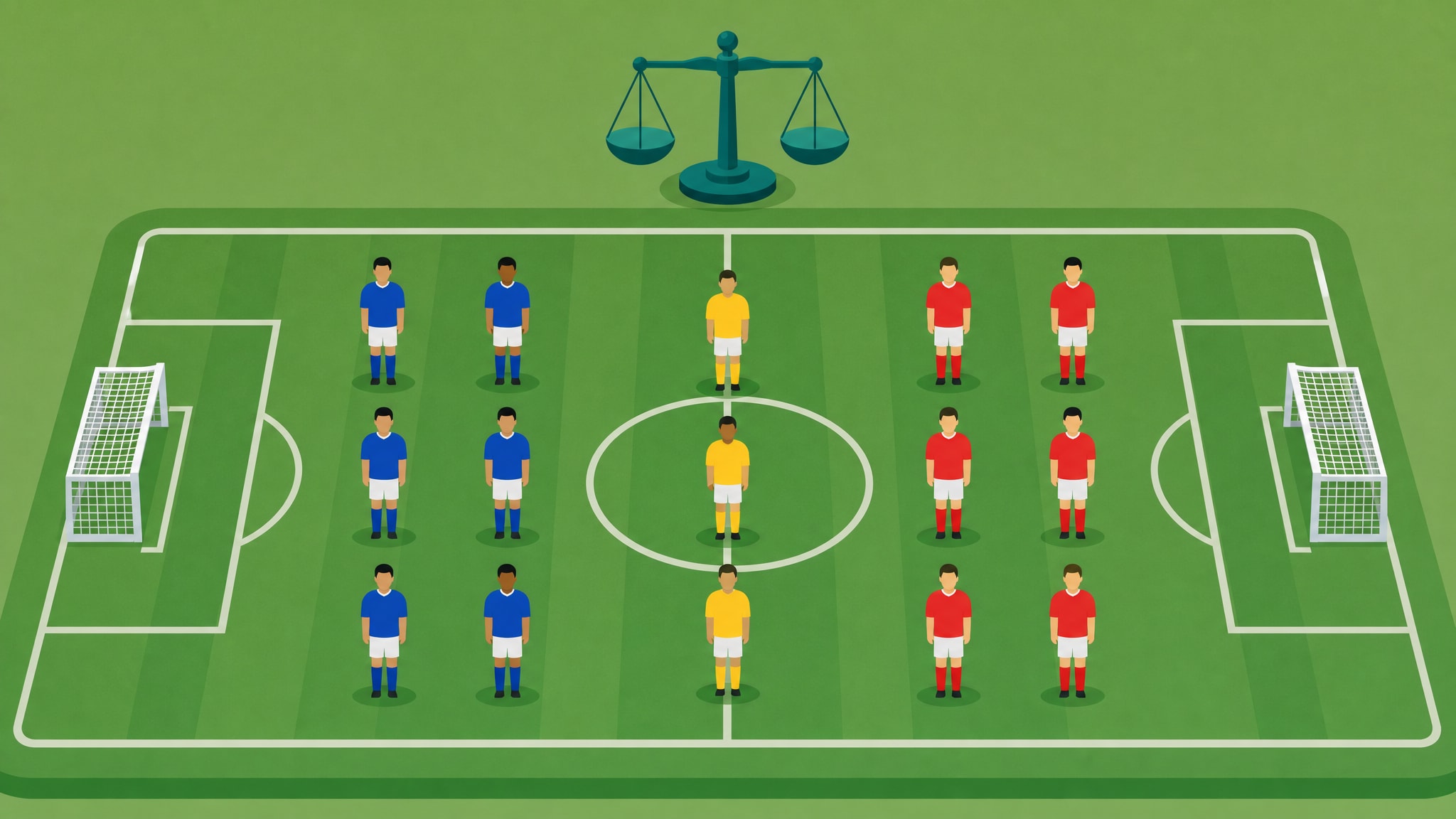
Rating-aware algorithms calculate total team strength before finalizing any lineup. The system weighs individual abilities against each other so both sides end up with comparable scores across attack, midfield, and defense. This approach to splitting players into fair teams eliminates the lopsided games that kill league momentum.
Competitive balance keeps your group engaged longer, because every match feels winnable. Players put in more effort when they know the outcome depends on performance, not a flawed sorting method.
How Rating-Based Team Generation Works
Effective balancing needs accurate input data before the algorithm can do its job. You cannot automate fairness without first deciding what fairness means for your specific group.
Assigning Accurate Player Skill Ratings
Initial ratings set the baseline for every team generated after that. You can import existing assessments, use peer voting, or set conservative starting values that adjust quickly as match results come in. A solid player skill rating system lets you score players with granularity, rather than forcing everyone into broad beginner or advanced buckets.
Getting this right early saves weeks of recalibration later. Vague categories hide real differences between players who sit in the same tier but perform very differently on the pitch.
Algorithmic Balancing vs Manual Sorting
Manual team sorting typically takes an organizer 15 to 30 minutes per session. Automated balancing does it in seconds. While you're still debating who should play where, an algorithm has already checked thousands of possible combinations and found the best split. That speed matters most when late arrivals or last-minute absences throw off your planned lineup.
Your time is better spent warming up than negotiating team compositions in a crowded group chat. Automation also removes the awkwardness of telling someone they're being moved down a team because the math said so.
Adjusting for Positions and Fitness Levels
Rating-based systems account for specific positional needs, rather than treating all players as interchangeable units. A highly rated defender doesn't balance out a highly rated striker if both teams end up short on goalkeeping. Advanced generators factor in preferred positions and current fitness levels to build lineups that actually function, not just ones that look equal on paper.
That contextual awareness is what separates a dedicated team balancer app for football from generic randomization tools. You get teams that work tactically, not squads that look balanced on paper but fall apart on the pitch.
Key Features of a Skill-Based Team Generator
Static ratings go stale fast as players improve, decline, or change roles within your group. Your tool has to evolve alongside your league to stay accurate through the season.
Real-Time Rating Adjustments After Matches
Post-match updates keep your skill-based team generator lined up with reality. Wins against stronger opponents boost ratings more than wins over weaker teams, and losses to lower-rated sides trigger the right corrections. That feedback loop means next week's teams reflect last week's actual performances, not outdated assumptions.
Without automatic adjustments, you're basically maintaining a spreadsheet with extra steps. The value of automation is continuous refinement without you having to touch it.
Integrating RSVPs with Team Creation
Availability changes constantly in amateur football, and your balancing tool has to handle that without friction. A late dropout needs instant re-sorting to keep the match competitive, and a last-minute addition needs to slot straight into the existing calculations. A capable football player rating app merges attendance tracking with team generation, so you never balance teams around players who never show up.
That's really the test: can the generator handle late dropouts or last-minute RSVP changes without making you start over? You update the roster and regenerate balanced lineups in moments.
Tracking Player Statistics to Refine Ratings
Match outcomes are raw material for smarter balancing decisions down the line. Individual stats like goals scored, assists, clean sheets, or defensive actions add texture beyond a simple win-loss record. Connecting your generator to a player stats tracker turns subjective impressions into performance data that sharpens rating accuracy over time.
Stats tracking improves future balance by revealing patterns that ratings alone miss. A midfielder with low goal output might still be essential through ball retention and distribution, and statistical tracking captures that where a basic rating wouldn't.
Data-driven refinement takes the bias out of player assessment. You stop relying on memory or reputation and start building teams on performance metrics gathered across multiple matches.
Moving Beyond Spreadsheets and Group Chats
Fragmented tools create fragmented management. Balancing teams in one app, tracking attendance in another, and messaging through a third guarantees information silos and missed updates.
Centralizing Rosters and Match History
Centralized management matters for skill-based sorting because ratings depend on complete historical data. When player profiles live in the same system as team generation and match results, every decision draws from a single source of truth. You eliminate version conflicts, lost spreadsheets, and the mental load of cross-referencing platforms before every session.
Your group deserves one home for all its football operations. Scatter critical information across messaging apps and documents, and consistent organizing becomes impossible no matter how disciplined you try to be.
Automating Communication for Organizers
Automated notifications cut the admin load that burns out volunteer captains. System-generated messages confirm registrations, announce team assignments, and remind players of upcoming matches, without you drafting any of it. That frees you to focus on the game itself instead of acting as a human notification service.
Communication failures cause more forfeits than skill imbalances do. Reliable automated messaging gets players the information they need on time, even when you're not around to send reminders yourself.
Choosing the Right Football Player Rating App
Not every team maker by ability delivers on its promises, and picking the wrong one wastes a whole season of calibration effort. You need clear criteria before you commit your group to a new system.
Essential Criteria for Amateur Organizers
Prioritize ease of use over feature complexity. The best rating system fails if players won't engage with it, or if setup takes longer than sorting teams by hand. Look for an intuitive interface, quick player onboarding, and balancing logic transparent enough to build trust rather than feel like a black box.
Check that the platform handles your specific format, whether that's five-a-side, seven-a-side, or full eleven-a-side matches. Generic sports tools often assume a standard format and break the moment you apply them to amateur football's varied setups.
Getting Your Group Started on FootDraw
Start simple and expand from there. Begin with basic ratings and let the system learn through several weeks of match data before turning on advanced features. Review FootDraw pricing plans to pick a tier that matches your group size and commitment level, then invite players to create profiles before your next scheduled session.
This tool isn't built for professional academies running video analysis or tactical periodization models. It's for amateur organizers who need practical, reliable team balancing without enterprise-level complexity or cost.
Sign up today to replace random chaos with rating-based precision. Your players will notice the difference in their very first balanced match.
Ready to organize your football team?
Build balanced teams, organize matches and track stats — all in one place.
Create Team