
Choosing the Best Formation for Amateur Football: 5, 7, and 11-a-side
Compare the most effective formations for amateur football. From 5-a-side diamonds to classic 11-a-side shapes, learn which tactic suits your team's skill level.
Índice
Choosing the Best Formation for Amateur Football
In amateur football, the best formation is rarely the most complex one. While professional teams use fluid systems that shift constantly, grassroots teams often struggle with basic positioning.
Choosing a shape that suits your players' fitness levels and technical ability is the fastest way to stop conceding easy goals. Whether you are playing 5-a-side on a weeknight or 11-a-side on a Sunday morning, organization usually beats individual flair.
The Best 5-a-Side Formations
5-a-side is fast and high-intensity. Because the pitch is small, every player must be prepared to defend and attack. Standing still is the easiest way to lose a 5-a-side match.
The Diamond (1-2-1)
This is widely considered the best formation for amateur football at the 5-a-side level. It provides a clear structure: one defender, two midfielders (wings), and one striker.
- Strengths: Provides balance and clear passing lanes. It is easy for players to understand their zones.
- Weaknesses: The midfielders require high fitness to cover both the defensive and attacking phases.
- When to use: Use this when you have two fit wingers and a disciplined defender who stays deep.
The Square (2-0-2)
This shape splits the team into two defenders and two attackers. It is common in small-sided games where players are still learning to communicate.
- Strengths: Very solid defensively if the two defenders stay back. Good for teams with limited fitness.
- Weaknesses: It creates a massive gap in the middle of the pitch. If the attackers don't drop back, the defenders can be easily overrun.
- When to use: Best for beginners or groups where players prefer to stay in fixed roles.
The Best 7-a-Side Formations
7-a-side introduces more tactical variety. The increased pitch size means you can no longer rely on one person to do all the running.
The Balanced 2-3-1
This is the most common 7-a-side formation. It features two defenders, three midfielders (one central, two wide), and one striker.
- Strengths: Offers width and a strong central presence. It is very hard to play through if the central midfielder is disciplined.
- Weaknesses: If the wide midfielders stay too high, the two defenders can be isolated in two-on-one situations.
- When to use: The standard choice for most competitive amateur teams.
The Solid 3-2-1 (The Christmas Tree)
This is a defensive-minded shape for teams that want to be hard to beat.
- Strengths: Extremely difficult to break down through the middle. Three defenders provide a massive safety net.
- Weaknesses: Can be very lonely for the lone striker. It lacks natural width unless the defenders overlap.
- When to use: Use this if you are playing against a significantly better team or if your defenders have lower 0-100 ratings and need extra support.
The Best 11-a-Side Formations
At the 11-a-side level, amateur football tactics often revert to simplicity because players rarely train together. Choosing the right football position for each player is as important as the shape itself.
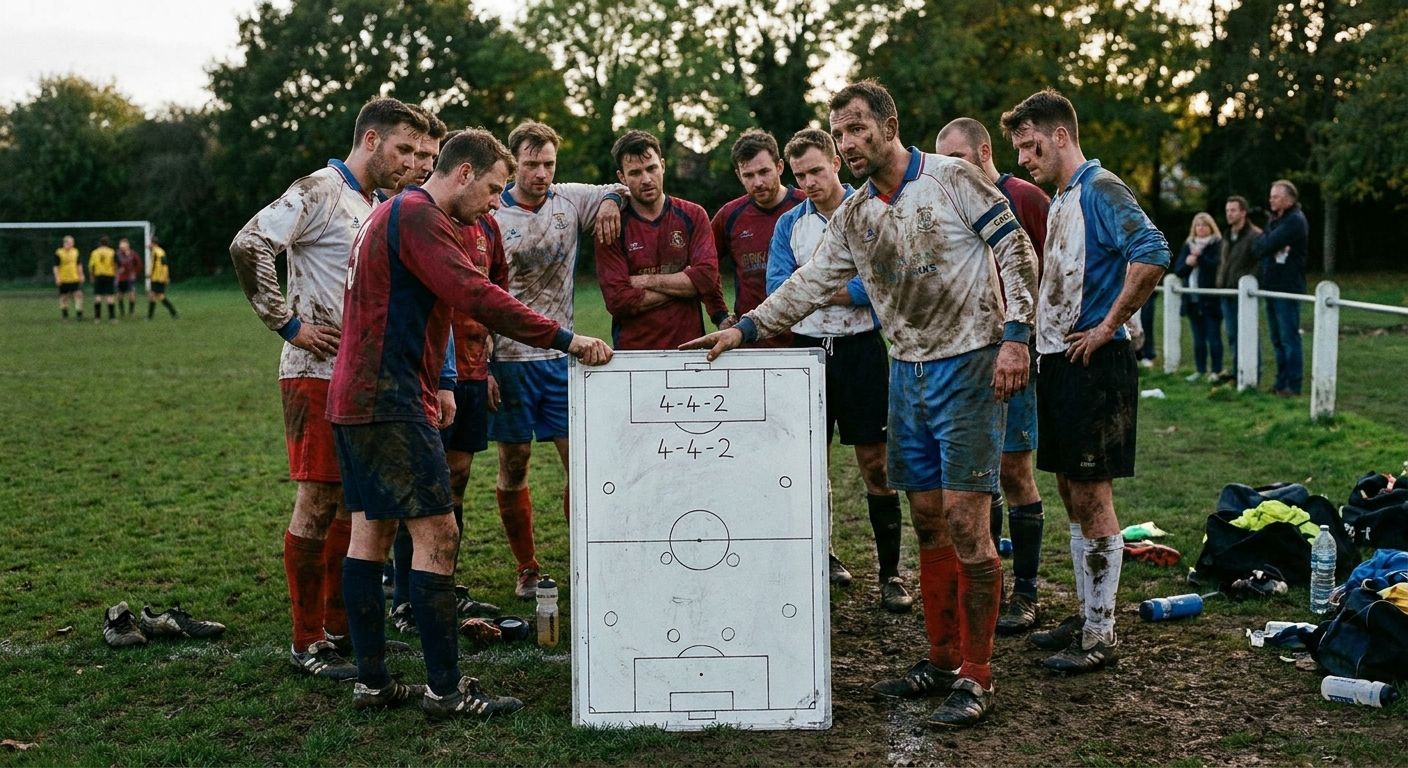
The Classic 4-4-2
There is a reason the 4-4-2 has survived for decades in the grassroots game. It is easy to explain and covers every blade of grass.
- Strengths: Two strikers put constant pressure on amateur defenders, who often make mistakes under heat. Two lines of four make the team very compact.
- Weaknesses: Can be overrun in midfield if the opponent plays with three central players.
- When to use: The best formation for amateur football teams that don't have much time to discuss tactics before kickoff.
The Modern 4-2-3-1
This is a great option if you have a variety of player skill levels. It uses two defensive midfielders to protect the back four.
- Strengths: Very difficult to counter-attack against. It allows your most creative player (the "10") to stay high without heavy defensive duties.
- Weaknesses: Requires a very disciplined pair of holding midfielders. If they both wander forward, the defense is exposed.
- When to use: Use this if you have one standout playmaker and two reliable "engines" in the middle.
Formation Comparison Table
| Format | Formation | Best For | Key Requirement |
|---|---|---|---|
| 5-a-side | 1-2-1 (Diamond) | Ball retention | Fit wingers |
| 5-a-side | 2-0-2 (Square) | Beginners | Fixed positions |
| 7-a-side | 2-3-1 | All-round balance | Disciplined CM |
| 7-a-side | 3-2-1 | Defending a lead | Strong back three |
| 11-a-side | 4-4-2 | Simplicity | Hard-working wingers |
| 11-a-side | 4-2-3-1 | Creative play | Two holding midfielders |
Tactical Tips for Amateur Organizers
- Keep it simple: Avoid complex instructions like "inverted full-backs." In amateur games, players usually just need to know who they are marking and which zone they occupy.
- Fitness dictates the shape: If your team has low fitness levels, don't play a high-pressing 4-3-3. You will be exhausted by the 60th minute. Stick to a compact 4-4-2 or 4-5-1.
- Check your ratings: Use FootDraw to look at your squad's 0-100 player ratings. If your defenders have lower ratings than your attackers, consider adding an extra man to the backline (e.g., moving from a 2-3-1 to a 3-2-1 in 7-a-side).
- Communicate transitions: The biggest problem in amateur tactics is the "lump." This is when the defense and attack become completely separated. Remind your midfielders that they must bridge that gap.
Summary
The best formation for amateur football is the one your players can actually execute. For 5-a-side, the Diamond (1-2-1) is the gold standard for movement. For 7-a-side, the 2-3-1 offers the best balance. In 11-a-side, the 4-4-2 remains the king of simplicity.
Focus on getting your players to hold their positions before you worry about advanced tactics. A team that stays in its shape is always harder to beat than a team of individuals running aimlessly.
Pronto para organizar seu time de futebol?
Monte times equilibrados, organize partidas e acompanhe estatísticas — tudo em um só lugar.
Criar time