
Futsal vs 5-a-Side: Rules, Pitch and Ball Differences
Understand the technical and practical differences between futsal and 5-a-side football, from low-bounce balls to pitch surfaces and core rule variations.
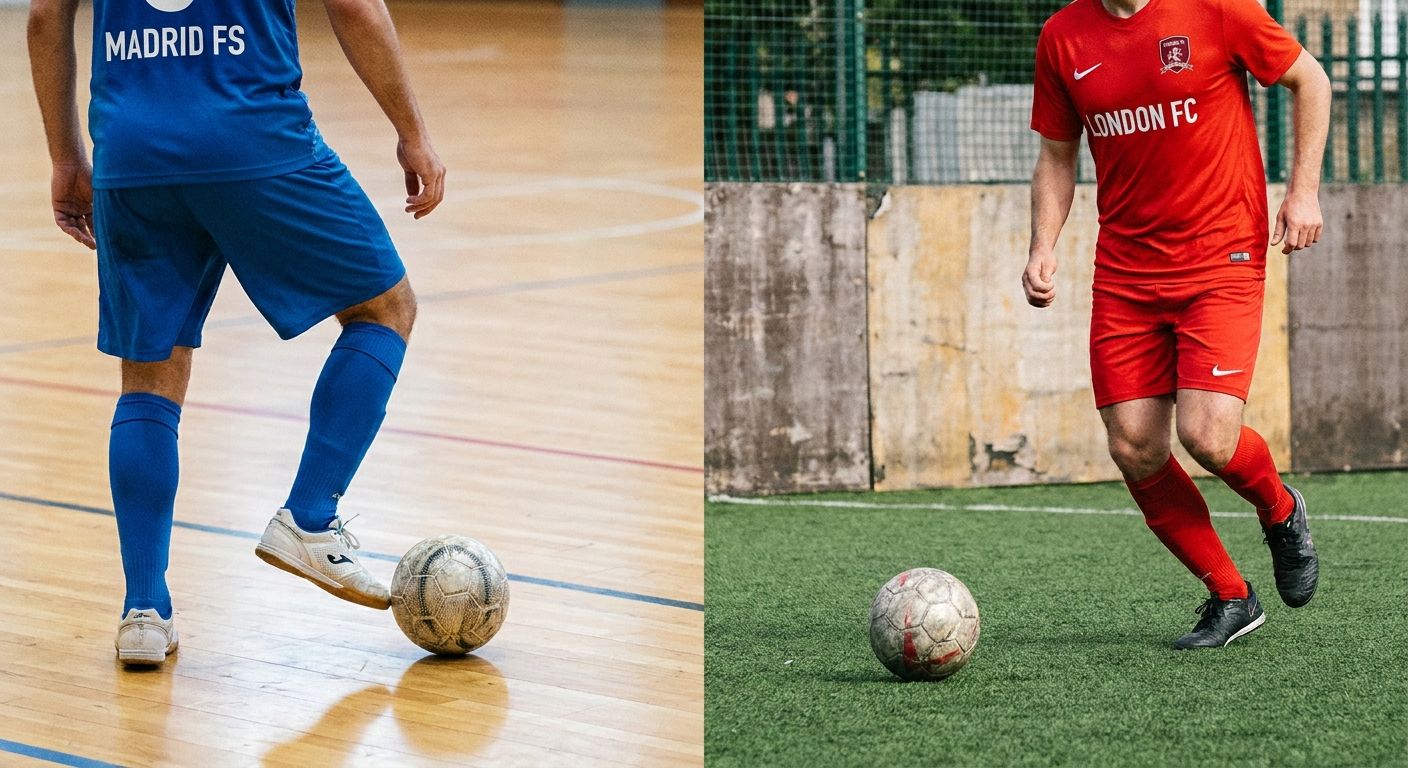
Table of contents
Futsal vs 5-a-Side: Key Differences for Players and Organizers
Many amateur players use the terms "futsal" and "5-a-side" interchangeably. However, while both involve ten players on a small pitch, they are distinct sports with different equipment, surfaces, and officiating.
If you are transitioning your weekly group from a local astroturf league to an indoor futsal court, understanding these differences is vital for a smooth game.
Comparison Overview
| Feature | Futsal | Traditional 5-a-Side |
|---|---|---|
| Surface | Hard court (wood or synthetic) | Artificial turf (3G/4G) or carpet |
| Ball | Size 4, low-bounce | Size 4 or 5, regular bounce |
| Boundaries | Touchlines (kick-ins) | Often boards or nets (play continues) |
| Goalkeeper | Can leave area, limited time on ball | Usually restricted to the area |
| Head Height | No height restriction | Often restricted to head height |
| Goal Size | 3m x 2m | Usually 12ft x 6ft or 16ft x 6ft |
The Pitch and Surface
One of the most immediate differences is the playing surface. Futsal is strictly played on hard, flat surfaces. This makes the game much faster and rewards players with high technical control.
Traditional 5-a-side is almost always played on artificial turf. This surface provides more friction, slowing the ball down and allowing for more physical, lunging tackles.
Futsal pitch dimensions are typically 25–42 meters in length and 16–25 meters in width. Because futsal uses touchlines instead of boards, the ball goes out of play frequently. This forces players to improve their passing accuracy under pressure.
The Ball: Why Size and Bounce Matter
The futsal ball size is usually a Size 4, but it is heavier and has significantly less bounce than a standard football. It is designed to stay on the floor, which is where the technical nature of futsal comes from.
In standard 5-a-side, players often use a regular Size 5 or a Size 4 ball. These have a much higher rebound. If you try to play futsal with a regular ball on a hard court, the game becomes chaotic as the ball bounces too high for easy control on the tight court.
Key Rule Variations
Restarts: Kick-ins vs. Boards
In futsal, when the ball goes over the touchline, the game restarts with a kick-in. You have exactly 4 seconds to take it, or the ball is turned over. In many 5-a-side leagues, the ball is simply played off the boards, meaning the game rarely stops.
The Goalkeeper
Futsal goalkeepers have more freedom to join the attack but are limited to 4 seconds of possession in their own half. In many amateur 5-a-side games, the keeper is strictly forbidden from leaving the semi-circle area.
Accumulating Fouls
Futsal has a unique "cumulative foul" rule. After a team commits five fouls in a half, every subsequent foul results in a direct free kick from the second penalty mark (10 meters out). Standard 5-a-side usually relies on simple direct or indirect free kicks with no tally kept.
Style of Play and Physicality
Futsal is often described as a game of "chess on court." It focuses on creative movement, rotations, and quick passing. Slide tackling is generally prohibited in futsal to protect players on the hard surface.
5-a-side is often more physical. Because the ball rarely goes out of play when boards are used, it becomes an intense game of endurance. The presence of the boards also allows for tactical use of the wall to beat a defender, a move that is impossible in futsal.
Transitioning Your Weekly Game
If you are organizing a game and moving between these formats, your player ratings will likely change. A player who is a "powerhouse" on a 3G pitch might struggle with the delicate first touch required on a futsal court.
Using FootDraw to manage your group allows you to keep track of these performance shifts. When you generate teams fairly, the app uses the 0–100 player rating scale to ensure the game stays competitive, regardless of the surface you choose that week.
Common Mistakes When Switching Formats
- Using the wrong ball: Playing futsal with a regular football leads to a "pinball" effect that ruins the game's flow.
- Ignoring the 4-second rule: In futsal, speed is essential. Taking too long on corners or kick-ins stalls the game's momentum.
- Over-reliance on the boards: Players used to 5-a-side often forget that futsal has touchlines. Passing the ball into the "wall" results in a turnover.
Ready to organize your football team?
Build balanced teams, organize matches and track stats — all in one place.
Create Team