How to Use a Football Team Generator by Position for Fairer Matches
Tired of one team having five strikers while the other has none? Learn how to use a football team generator by position to balance your amateur matches and improve game quality.
Table of contents
- 👋 Introduction
- 🛡️ The Danger of Positional Imbalance
- 📍 Defining Roles in Your Squad
- ⚖️ Using the 0–100 Rating System for Positions
- 🏆 Why Successful Teams Use FootDraw
- ❌ Common Mistakes That Limit Growth
- 💡 Growth Checklist for Amateur Football Teams
- ❓ Frequently Asked Questions
- 🎯 Conclusion
- 🚀 Try FootDraw for Free
How to Use a Football Team Generator by Position for Fairer Matches
👋 Introduction
Imagine your Tuesday night 5-a-side game is about to start.
You look at Team A and realize they have four players who only want to play as strikers.
Meanwhile, Team B has three natural defenders and a solid goalkeeper.
By half-time, the score is 8-0 and half your players have stopped running.
Positional imbalance is one of the quickest ways to ruin a good grassroots football match.
Using a balance teams by position that accounts for player roles ensures every game stays competitive until the final whistle.
🛡️ The Danger of Positional Imbalance
Most amateur organizers only think about overall skill levels when picking teams.
They try to balance the "best" players against the "developing" players.
However, skill alone doesn't tell the full story of how a match will play out.
If one team is physically dominant but has no one willing to track back, they will struggle against a structured side.
Competitive games happen when both squads have a functional spine from back to front.
💡 Pro Tip: Always ask new players for their preferred position before their first game to avoid stacking one side with "goal-hangers."
📍 Defining Roles in Your Squad
In amateur football, you don't need complex tactical instructions.
You just need to know who is comfortable where.
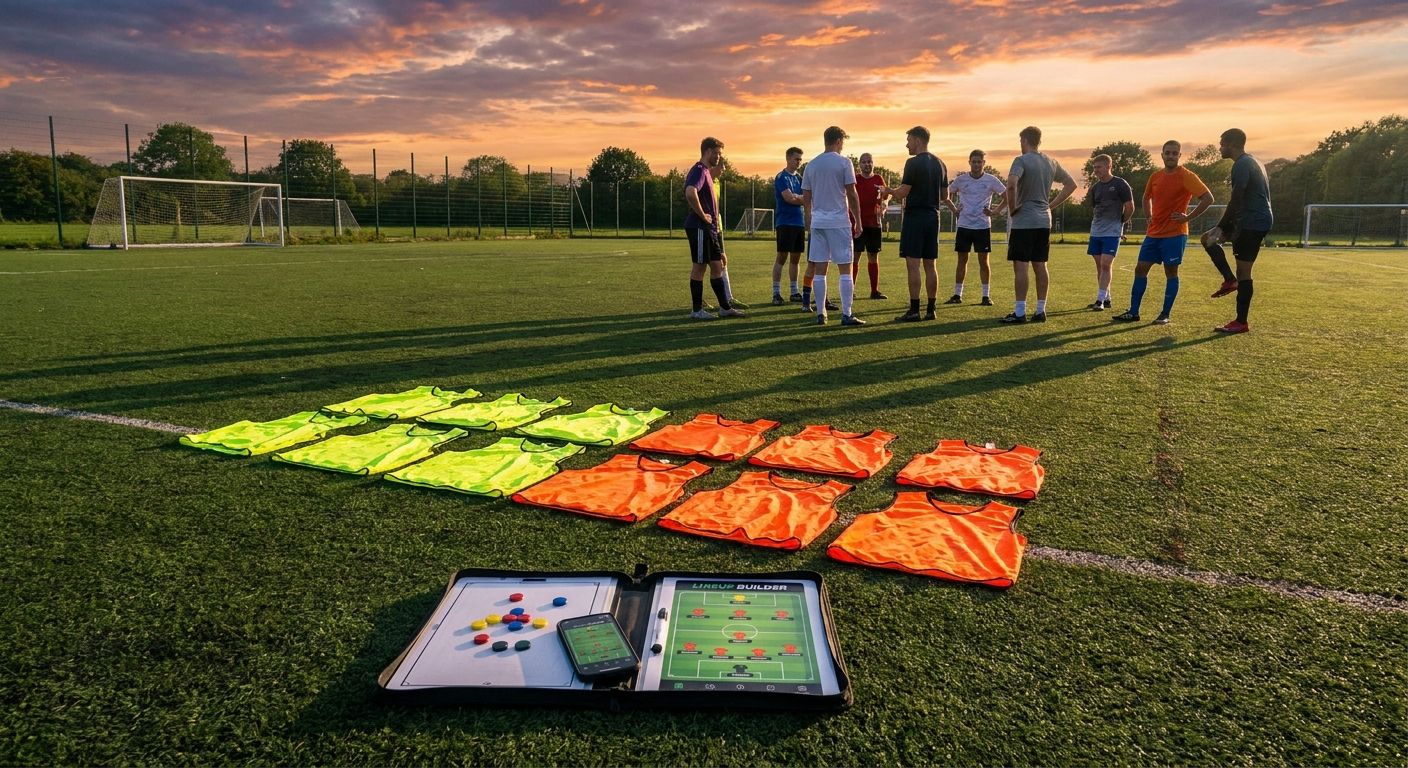
Break your squad down into four simple categories:
- Goalkeepers: The specialists who rarely want to play outfield.
- Defenders: Players who enjoy tackling and starting the play from deep.
- Midfielders: The engines who can transition between defense and attack.
- Forwards: The finishers who thrive in the final third.
When you use a Random Team Generator, try to ensure these roles are distributed evenly.
This prevents the "chaos ball" scenario where everyone is chasing the ball in the same corner of the pitch.
⚖️ Using the 0–100 Rating System for Positions
To get the most out of a generator, you must use a consistent rating system.
FootDraw uses a 0–100 player rating system to help organizers quantify ability.
When rating by position, consider how a player's score impacts their role.
A player might be an 85-rated striker but only a 60-rated defender.
If you force that 85-rated player into a defensive role, the teams might look balanced on paper but will be lopsided on the pitch.
Tracking Football Statistics like goals and clean sheets over time helps you refine these ratings.
🏆 Why Successful Teams Use FootDraw
Managing a team in a messy WhatsApp thread makes it impossible to track who plays where.
FootDraw simplifies this by centralizing your player data in one web app.
Organizers can view player profiles and see their specific 0–100 ratings at a glance.
When you create a match, the app collects RSVPs and allows you to generate fair, balanced teams with a single click.
If the generated teams look a little heavy on attackers, you can manually adjust them before sharing the line-ups.
You can then share these balanced teams directly to your WhatsApp or Telegram group.
❌ Common Mistakes That Limit Growth
- Ignoring Player Preference: Forcing a natural defender to play striker every week leads to frustration and lower retention.
- Rating Players Only on Goals: A high-rated defender is just as valuable as a high-rated striker for match balance.
- Last-Minute Team Picking: Scrambling to pick teams at the pitch leads to bias and arguments.
- Static Ratings: Players improve or decline; keep your 0–100 ratings updated every few weeks.
💡 Growth Checklist for Amateur Football Teams
- Survey your players on their 1st and 2nd choice positions.
- Assign a 0–100 rating to every player in your squad.
- Use an automated generator to avoid accusations of favoritism.
- Track weekly attendance to identify your most reliable "core" players.
- Review match results to see if certain player combinations are too strong.
❓ Frequently Asked Questions
What is the best way to split teams for 5-a-side?
The best way is to use a generator that considers both skill level and player roles. This prevents one team from being entirely defensive or offensive.
How do I rate a player I've never seen play?
Start them at a baseline (e.g., 50 on the 0–100 scale) and adjust their rating after 2–3 games based on their performance.
Should I let players pick their own teams?
Generally, no. This often leads to "cliques" and lopsided games. An independent organizer or app-based generator is much fairer.
How many strikers do I need for a 7-a-side game?
Ideally, you want at least two players on each team who are comfortable finishing, but balance is key. One striker, three midfielders, and two defenders is a common balanced setup.
Why do player ratings matter so much?
They provide a data-driven way to ensure competition. Without them, you are just guessing, which leads to 15-0 scorelines.
🎯 Conclusion
Organizing a football match isn't just about showing up with a ball.
It’s about creating an environment where every player feels they have a chance to win.
By using a football team generator by position, you eliminate the tactical chaos that ruins amateur games.
Balanced teams lead to better games, higher player satisfaction, and a growing football community.
🚀 Try FootDraw for Free
Ready to end the matchday drama?
Stop chasing RSVPs in WhatsApp and start building a professional amateur club.
Use FootDraw to manage your players, track stats, and generate perfectly balanced teams today.
Ready to organize your football team?
Build balanced teams, organize matches and track stats — all in one place.
Create Team