
7-a-Side Football Rules and Pitch Dimensions: The Complete Guide
A comprehensive reference for 7-a-side football, covering official pitch dimensions, goal sizes, offside rules, and common match variations for amateur organizers.
Inhaltsverzeichnis
7-a-Side Football Rules and Pitch Dimensions
7-a-side football is the most popular bridge between the high-intensity sprint of 5-a-side and the tactical endurance of the full 11-a-side game. Because it is often played on third-generation (3G) artificial grass or partitioned 11-a-side pitches, the rules can vary slightly depending on the league or venue.
This guide provides the standard reference for 7-a-side football rules, pitch dimensions, and match requirements to help organizers run consistent and fair games.
7-a-Side Pitch Size and Dimensions
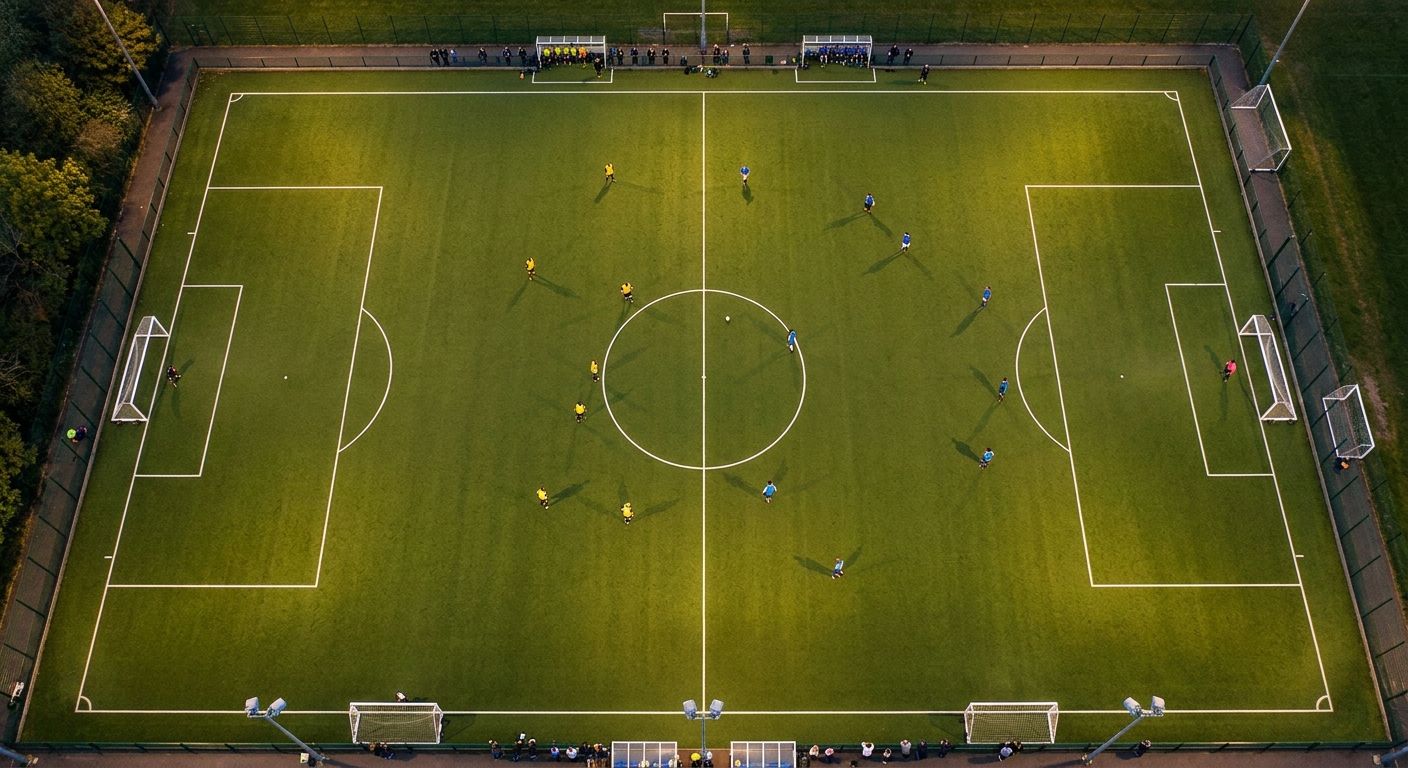
The 7 a side pitch size is significantly larger than a 5-a-side court, allowing for more structured play and positional roles. While exact sizes often depend on local facility markings, the following are the recognized standards.
Standard Dimensions
| Feature | Recommended Metric | Recommended Imperial |
|---|---|---|
| Length | 50m – 60m | 55yd – 65yd |
| Width | 30m – 40m | 33yd – 44yd |
| Penalty Area | 10m x 18m | 11yd x 20yd |
| Penalty Spot | 7m from goal line | 8yd from goal line |
| Center Circle | 6m radius | 6.5yd radius |
In many grassroots settings, seven a side football dimensions are created by playing across one-half of a standard 11-a-side pitch. This usually results in a slightly wider playing area, which is excellent for wing play.
7-a-Side Goal Size
The standard 7 a side goal size is 12 feet wide by 6 feet high (3.66m x 1.83m).
Some senior amateur leagues or youth age groups (U11/U12) may use 16ft x 6ft goals. However, for the majority of small-sided adult commercial leagues and casual bookings, the 12x6ft goal is the industry standard.
Core 7-a-Side Football Rules
While the Laws of the Game generally follow FIFA or FA standards, 7-a-side has specific adaptations to keep the game flowing on a smaller surface.
1. The Offside Rule
One of the most frequent questions for organizers is about the 7 a side rules offside policy. In the vast majority of small-sided amateur games, there is no offside rule.
However, some competitive leagues implement a "halfway line" or "third-line" offside rule to prevent "goal hanging." If your league does not explicitly mention offside in its handbook, it is almost certainly played without it.
2. Match Duration
7-a-side matches typically consist of two equal halves. Common formats include:
- Leagues: 20 minutes per half (40-minute total).
- Tournaments: 7 to 10 minutes per half.
- Casual Bookings: Usually played as a continuous 60-minute block.
3. Substitutions
7-a-side uses rolling substitutions. A player who has been replaced may return to the pitch as a substitute for another player later in the game.
Substitutions should only take place when there is a break in play and with the referee’s permission. If you are organizing a game via FootDraw, tracking these players and their relative player ratings (on a scale of 0-100) helps ensure that even with frequent rotations, the game remains balanced.
4. Goal Kicks and Goalkeepers
- Goal Kicks: Usually taken from the ground anywhere within the penalty area. In some variations, the goalkeeper must throw the ball out.
- Back-Pass Rule: Most modern 7-a-side leagues enforce the back-pass rule. If a defender intentionally passes to the keeper, the keeper cannot pick the ball up. If they do, an indirect free kick is awarded.
- Area Entry: Unlike 5-a-side, outfield players are typically allowed to enter the penalty area, and goalkeepers are allowed to leave it.
5. Throw-ins vs. Kick-ins
Standard 7-a-side rules require traditional overhead throw-ins. However, many 3G pitch centers use "kick-ins" (where the ball is placed on the touchline and kicked in) to speed up play and prevent the ball from constantly leaving the cage.
Common Rule Variations
Before starting a new season or booking a pitch, check these three common variations with the facility or league secretary:
- Height Scale: Is the ball allowed to go over head height? On outdoor 7-a-side pitches, there is usually no height restriction, unlike indoor 5-a-side.
- Slide Tackling: Many amateur leagues ban slide tackling to reduce the risk of injury on artificial surfaces.
- Free Kick Distance: Opposing players must usually stand at least 5 meters (6 yards) away from the ball during free kicks.
Organizing Your Game
Successful 7-a-side requires more than just knowing the dimensions. You need exactly 14 reliable players to avoid uneven matches.
Using a tool like FootDraw can simplify this by managing your RSVPs and automatically generating fair teams based on 0-100 player ratings. This ensures that even if you're playing on a slightly non-standard pitch, the quality of the competition remains high.
Bereit, dein Fußballteam zu organisieren?
Erstelle ausgewogene Teams, organisiere Spiele und verfolge Statistiken — alles an einem Ort.
Team erstellen